IN OTHER WORDS / BOOK DESIGN
OVERVIEW
In Other Words
In Other Words is a questioning into how meaning emerges through relational encounters with language, text, and of others. The project began with a failed attempt to write a novella—a failure that revealed a deeper insight. Each time I tried to articulate an idea, I found that someone else had already given it clearer form. Rather than treat this as a limitation, I took it as a condition of being-in-language. Our thinking is always already entangled with the words of others; we speak through a field of influences. The book embraces that condition by constructing a narrative entirely from quotations.
The title, In Other Words, signals this orientation. It points to language as a practice of re-articulation, re-translation, and re-statement. Meaning is not fixed in an original source but takes shape in the movement from one expression to another. The project aligns with a phenomenological understanding of language, as a lived medium—something we inhabit and through which our world becomes intelligible.
Complicated Authorship
I was influenced by thinkers such as Martin Buber, whose I–Thou framework positions the “Other” not as an external object but as a relation that opens the possibility of meaning. Meaning flows from encounter—from the interval between Self and Other. This stance is woven through the book’s structure: each quotation becomes a site of encounter, a moment of being addressed. The reader is invited into a chain of relations rather than a singular authorial voice.
“This work consists of two parts: the part that I have written and the part that I have not written, and precisely this second part is the important one.”
Wittgenstein’s reflection on what cannot be said provides the conceptual threshold for the book. Language is an activity bounded by silence, by what resists articulation. The book’s visual montage of voices gestures toward this negative space: the unsaid is what holds the fragments together.
Material decisions
The open kettle-stitch binding with white thread serves as a literal and metaphorical through-line—a visible structure that holds disparate voices in tension. The shift from black-and-white to colour printing marks a kairotic moment, a rupture in the visual field that signals transformation. The typography is deliberately inconsistent, moving, expanding, and contracting tracing the phenomenological experience of reading: unstable, dynamic, unfolding.
Developed in the aftermath of the COVID-19 pandemic, the book also registers the strange simultaneity of that moment—physical separation alongside digital saturation. It operates partly as a design diary, partly as an attempt to map the shifting ground of attention, interiority, and world-understanding during a period of collective disorientation. The fragmentation is intentional; it echoes a world in which meaning is continually reassembled.
In Other Words ultimately positions design as a practice of arrangement rather than invention. It treats the book as a site where voices converge and where the reader’s own interpretive activity completes the work. Meaning is not presented; it is enacted. The book does not claim authority over its materials but stages an encounter with them. In this sense, the project is less about producing a text and more about cultivating a field of relations—a space where the other becomes the source from which understanding arises.
In Other Words
In Other Words is a questioning into how meaning emerges through relational encounters with language, text, and of others. The project began with a failed attempt to write a novella—a failure that revealed a deeper insight. Each time I tried to articulate an idea, I found that someone else had already given it clearer form. Rather than treat this as a limitation, I took it as a condition of being-in-language. Our thinking is always already entangled with the words of others; we speak through a field of influences. The book embraces that condition by constructing a narrative entirely from quotations.
The title, In Other Words, signals this orientation. It points to language as a practice of re-articulation, re-translation, and re-statement. Meaning is not fixed in an original source but takes shape in the movement from one expression to another. The project aligns with a phenomenological understanding of language, as a lived medium—something we inhabit and through which our world becomes intelligible.
Complicated Authorship
I was influenced by thinkers such as Martin Buber, whose I–Thou framework positions the “Other” not as an external object but as a relation that opens the possibility of meaning. Meaning flows from encounter—from the interval between Self and Other. This stance is woven through the book’s structure: each quotation becomes a site of encounter, a moment of being addressed. The reader is invited into a chain of relations rather than a singular authorial voice.
“This work consists of two parts: the part that I have written and the part that I have not written, and precisely this second part is the important one.”
Wittgenstein’s reflection on what cannot be said provides the conceptual threshold for the book. Language is an activity bounded by silence, by what resists articulation. The book’s visual montage of voices gestures toward this negative space: the unsaid is what holds the fragments together.
Material decisions
The open kettle-stitch binding with white thread serves as a literal and metaphorical through-line—a visible structure that holds disparate voices in tension. The shift from black-and-white to colour printing marks a kairotic moment, a rupture in the visual field that signals transformation. The typography is deliberately inconsistent, moving, expanding, and contracting tracing the phenomenological experience of reading: unstable, dynamic, unfolding.
Developed in the aftermath of the COVID-19 pandemic, the book also registers the strange simultaneity of that moment—physical separation alongside digital saturation. It operates partly as a design diary, partly as an attempt to map the shifting ground of attention, interiority, and world-understanding during a period of collective disorientation. The fragmentation is intentional; it echoes a world in which meaning is continually reassembled.
In Other Words ultimately positions design as a practice of arrangement rather than invention. It treats the book as a site where voices converge and where the reader’s own interpretive activity completes the work. Meaning is not presented; it is enacted. The book does not claim authority over its materials but stages an encounter with them. In this sense, the project is less about producing a text and more about cultivating a field of relations—a space where the other becomes the source from which understanding arises.
SERVICES
Creative Direction
Print Design
Type Design
Kettle Stitch Binding
Creative Direction
Print Design
Type Design
Kettle Stitch Binding
YEAR
2022-2023
2022-2023
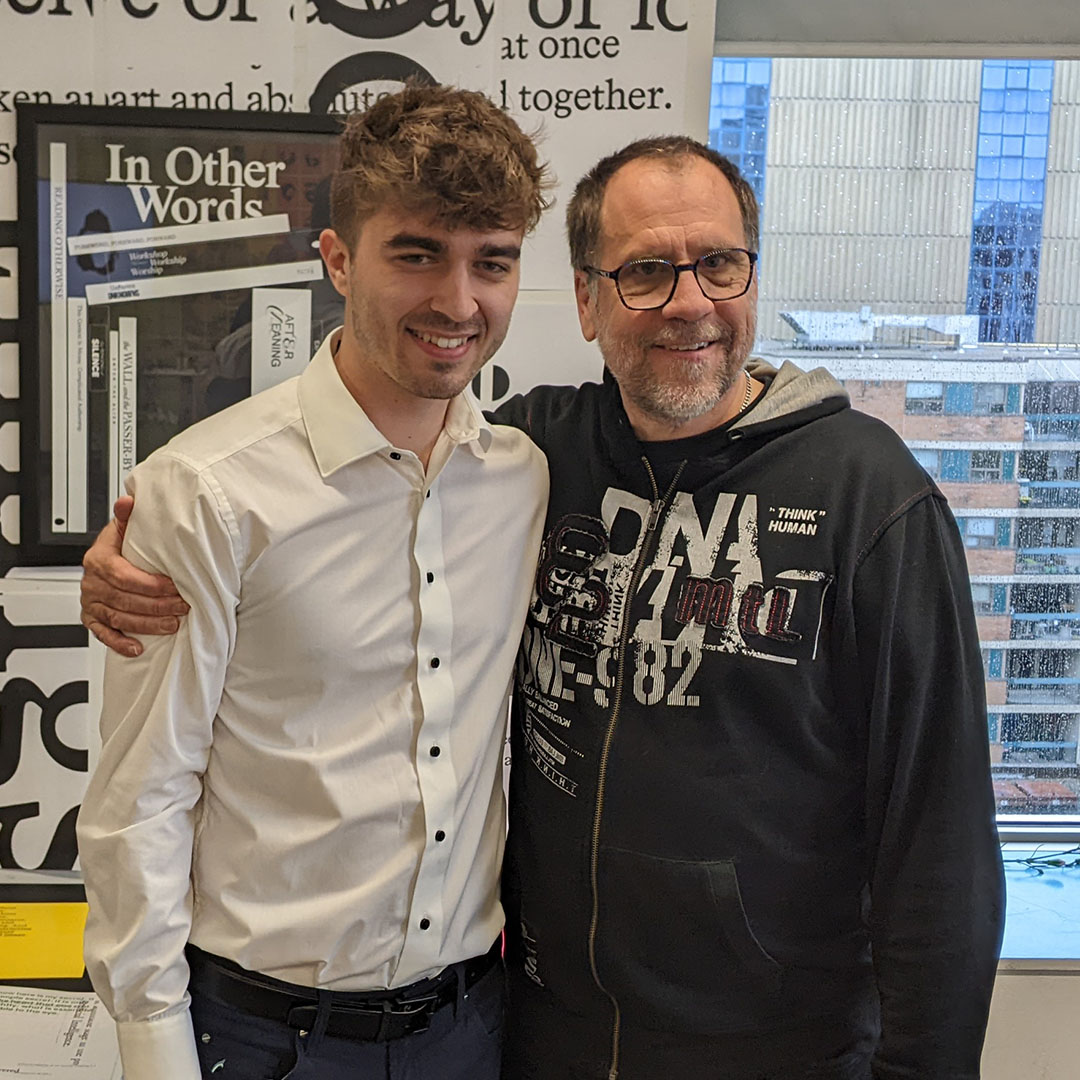
University of Toronto professor John Vervaeke, right. Colin Lawrence, left. Pictured at OCAD University, Grad Ex 2023
 © 2026,
All Rights Reserved
© 2026,
All Rights Reserved